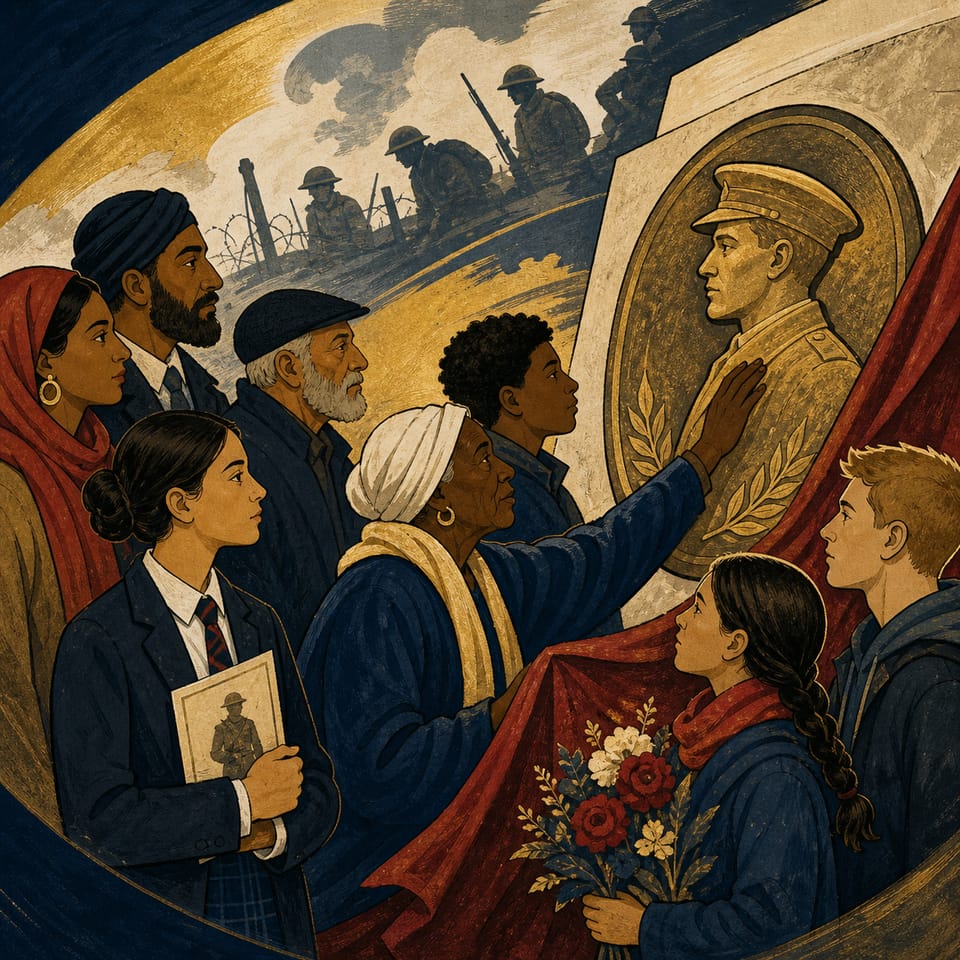
Lessons/After the memorial: how communities remember
Code an unveiling page where a click reveals an elder's line.
After the memorial: how communities remember
Walter Tull and a town's choice
Social SciencesCoding
Students create a memorial program and leaflet, choose which evidence from Walter Tull's life to foreground, and show how that framing shapes a community's response.
Pacing
1 week · 5 × 45 min
Grade
Grade 10
Coding
Beginner
Students codePlayer ActionsOn Page StartSequenceParallelBackground Music
Opens a private practice project in the Studio — no account needed.
How do communities choose whom to remember and why?
Students will be able to
Write a program title, subtitle, and scene text
Explain why one piece of evidence about Tull matters for memory
Code a click interaction that reveals a written speech line
Design a cover with background, image, and autoplay music
Key vocabulary
commissioncommemorationmemorial
Assessment
Formative
Organizer drafts, exit tickets, and peer-review checks along the way.
Summative
A published, playable interactive story.
The student journey
This is a build — not a worksheet packet
Every lesson runs like the story students are about to make: read it, write it, build it, polish it, publish it. The printables scaffold each stage — the published Elementari project is the destination.
1
📖
Read
Students read a short, high-interest passage — a real-world hook, not a dry textbook definition — to spark ideas for what they'll make.
📖A Story Cast in Bronze
On March 25, 1918, during the massive German Spring Offensive in France, Second Lieutenant Walter Tull was killed leading his men in a counter-attack near the village of Favreuil. The soldiers under his command, who respected him deeply, br…
In the studio, students bring the project to life — adding art and following the exact writing and coding steps shown below. The Studio Compass walks them through it, one step at a time.
🧭Studio CompassStep 1 / 6
TITLE PAGE
Key words — tap to learnOn Click
Each step checks off & advances on its own
All 6 studio steps · dynamic to the project
1TITLE PAGE
2Build the opening
3Build the opening
4Build the build-up
5Build the build-up
6Build the ending
4
🔁
Polish
ongoing
Teacher and peer feedback pin right onto the project — students revise until it's ready to share.
Feedback on the project2 pins
🍎
Add one more sentence here so readers get the full picture.
👍 2Teacher
A
The interaction is clear — it helps the reader follow the project!
A couple of things to gather, a few quick steps to prep — then you're ready to hand it to students.
What you need
A device per student or pair
Internet connection
Prep · about 10 min
1Print the student kits
2Assign this lesson to your students
3Skim the build steps
Teacher background
What you need to know
Communities select particular facts and stories to highlight; memorials and campaigns can correct past omissions and reshape public memory by emphasizing evidence that supports a different narrative.
Key terms
commission
An official appointment that gives someone authority and rank in the military.
commemoration
An act or event that remembers or honors a person or moment from the past.
memorial
A structure or event created to remember people who have died or an important past event.
Watch for these misconceptions
✕
making a confident claim without linked evidence →Prompt: 'Which sentence in your text shows the evidence for that claim?'
✕
unclear claim/evidence organization →Have the student map one claim and one supporting sentence on a quick organizer before revising.
Standards alignment
Aligned to the standards you teach
Every task maps to a specific standard, so planning and reporting are covered.
Tracking 7 frameworks: Common Core ELA, Common Core Math, NGSS +4
Common Core State Standards — English Language Arts
6 standards
RH.9-10.1
Cite specific textual evidence to support analysis of primary and secondary sources, attending to such features as the date and origin of the information.
SL.9-10.4
Present information, findings, and supporting evidence clearly, concisely, and logically such that listeners can follow the line of reasoning and the organization, development, substance, and style are appropriate to purpose, audience, and task.
SL.9-10.5
Make strategic use of digital media (e.g., textual, graphical, audio, visual, and interactive elements) in presentations to enhance understanding of findings, reasoning, and evidence and to add interest.
WHST.9-10.1
Introduce precise claim(s), distinguish the claim(s) from alternate or opposing claims, and create an organization that establishes clear relationships among the claim(s), counterclaims, reasons, and evidence.
Also addressedW.9-10.1 · W.9-10.3
Full task-by-task mapping — including Depth of Knowledge — is in the answer key.
Differentiation & accessibility
Built to reach every learner
One lesson, three built-in paths — with accessibility baked into the materials, not bolted on afterward.
Extra support
Emerging readers & writers
Read-aloud and multilingual support in the Elementari build
Studio Compass highlights one task at a time — including the coding
Sentence frames and a word bank so it is never a blank page
On grade
The core lesson
The passage and storyboard exactly as written
Model answers and “look-fors” in the answer key
Self-check chips at every milestone
Ready for more
Extension & challenge
Challenge vocabulary and a real-world extension question
Deepen one existing page or interaction — without changing the required mechanics
A longer, evidence-based reflection prompt
Accessibility, built inPredictable step-by-step structureOne task at a time · Studio CompassHighlighted response areasLow-stimulation printMovement-friendly pacingDesigned so every student can design, write, and code — with ADHD, autism, and dyslexia in mind.
Questions
Teacher FAQ
Do I — or my students — need to know how to code?
No. Coding concepts are introduced in plain language exactly when students need them, and Studio Compass confirms each milestone so students keep moving without you troubleshooting. The teacher guide walks you through the whole build, answers included.
How long does this lesson take?
About 1 week, paced into 45-minute class periods. You can spread it out or compress it — students pick up where they left off, so it doesn't have to finish in one sitting.
What devices does this lesson work on?
Students can read, write, code, and publish on Chromebooks, iPads, tablets, laptops, or desktops. All they need is a modern browser — nothing to download or install.
What is Studio Compass?
Studio Compass is the step-by-step guide inside the Studio. It shows students what to do next, identifies the exact coding blocks they need, and confirms completed milestones so they can keep moving independently.
How does this lesson support different learners?
This lesson includes read-to-me with synchronized highlighting, a built-in glossary, and picture-based storyboarding, with writing and coding scaffolds you can dial up or down. Students can work with guided support or more independently — and still finish the same project.
Ready when you are
Bring this lesson to your class
Import your class, assign in one click, and watch them build — the whole kit comes with it.