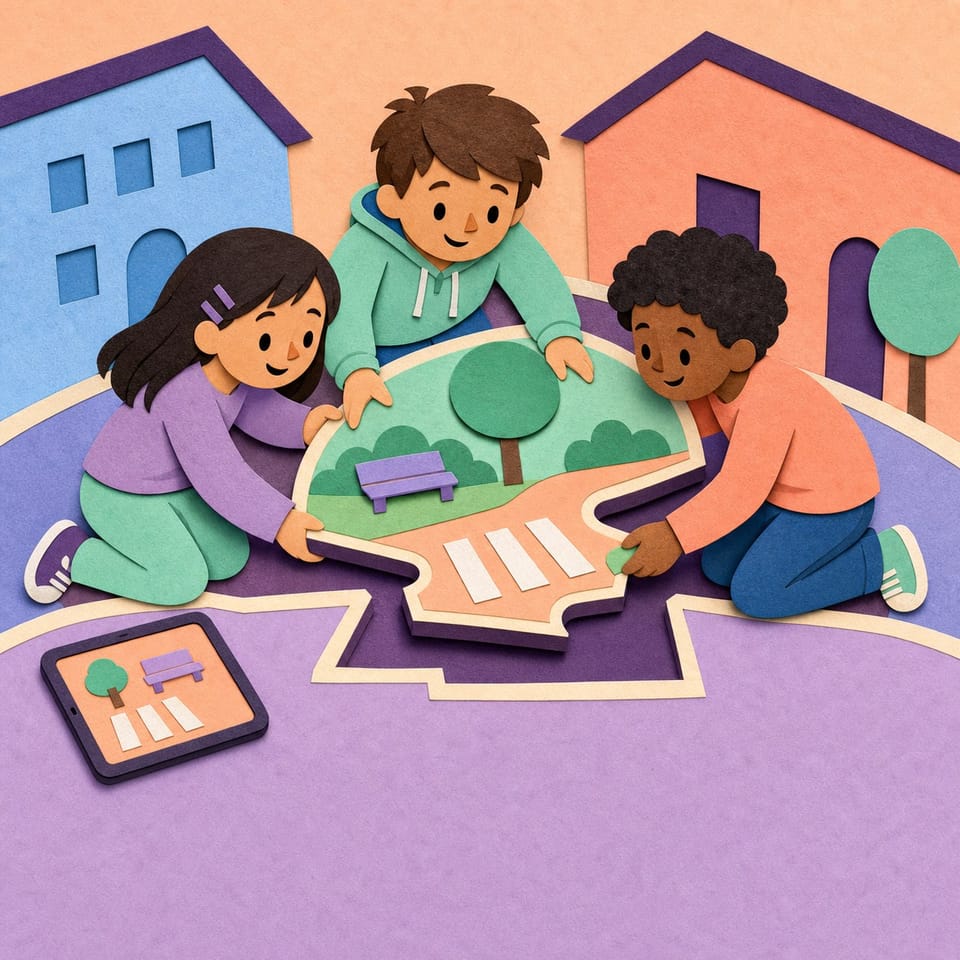
Empower students to create an app addressing community issues. This project blends coding and problem-solving, teaching kids how technology can drive social…
Pacing
1 class · 60 min
Grade
Grade 3
Coding
Beginner
Students codePlayer ActionsOn Page StartSequenceParallelNavigation
Opens a private practice project in the Studio — no account needed.
How does clear communication turn a local problem into local action?
Students will be able to
Research and Identify a community issue and brainstorm ways an app can address it.
Design a storyboard outlining the structure and flow of the app.
Create an interactive app using Elementari to bring the app idea to life.
Test and Share the app with peers for feedback.
Key vocabulary
leadfaucetaudience
Assessment
Formative
Use milestone checks, organizer responses, and daily test evidence to guide feedback.
Summative
The app explains the issue accurately, represents affected people respectfully, and offers a realistic action and trustworthy resource. Labels predict their destinations, every page returns correctly, and the READER can reach information and resources without getting lost.
The student journey
This is a build — not a worksheet packet
Every lesson runs like the story students are about to make: read it, write it, build it, polish it, publish it. The printables scaffold each stage — the published Elementari project is the destination.
1
📖
Read
Students read a short, high-interest passage — a real-world hook, not a dry textbook definition — to spark ideas for what they'll make.
📖The Eight-Year-Old Who Made a President Listen
In 2014, the water in Flint, Michigan changed. It came out of faucets looking brown. It smelled wrong. Families kept saying so — and for months, many leaders told them the water was fine. It was not. The pipes were leaking lead, a metal tha…
In the studio, students bring the project to life — adding art and following the exact writing and coding steps shown below. The Studio Compass walks them through it, one step at a time.
🧭Studio CompassStep 1 / 6
Introduction to Community Issues and App Design 💡
Discuss Community Issues: Talk about common problems in the community, such as: Environmental Issues: Recycling, reducing pollution, conserving water. Social Issues: Helping the el
Key words — tap to learnon page start block
Each step checks off & advances on its own
All 6 studio steps · dynamic to the project
1Introduction to Community Issues and App Design 💡
2Design the Home Page 🏠
3Create the Information Screen 📚
4Developing the Resource Screen 📂
5Coding Navigation on the Home 🖱️
6Final Review and Presentation 🎤
4
🔁
Polish
ongoing
Teacher and peer feedback pin right onto the project — students revise until it's ready to share.
Feedback on the project2 pins
🍎
Add one more sentence here so readers get the full picture.
👍 2Teacher
A
The interaction is clear — it helps the reader follow the project!
A couple of things to gather, a few quick steps to prep — then you're ready to hand it to students.
What you need
A device per student or pair
Internet connection
Prep · about 10 min
1Print the student kits
2Assign this lesson to your students
3Skim the build steps
Teacher background
What you need to know
Students learn that problems get solved when they are explained so the right audience can act: name what is happening, show who is affected, and point to a specific next step. Mari Copeny's letter models the pattern; students apply it by structuring their app into an explanation page and a resources page that give a reader something concrete to do.
Key terms
lead
a soft metal that is poisonous for people, especially children
faucet
the tap where water comes out of a sink
audience
the people a message is written for
Watch for these misconceptions
✕
The app presents an unsupported claim or a solution that one person cannot realistically deliver. →Return to the source notes and separate evidence, proposed action, and hoped-for effect.
✕
Both home buttons lead to the same page or their labels do not predict the destination. →Create a three-page route map and test each button from the home screen and back.
Standards alignment
Aligned to the standards you teach
Every task maps to a specific standard, so planning and reporting are covered.
Tracking 7 frameworks: Common Core ELA, Common Core Math, NGSS +4
CCSS · ELA6CSTA4ISTE11AASL3C315 frameworks · 25 standards · DOK 3
CCSS · ELA
Common Core State Standards — English Language Arts
6 standards
CCSS.ELA-LITERACY.W.4.2
Write informative/explanatory texts to examine a topic and convey ideas and information clearly.
CCSS.ELA-LITERACY.W.4.5
With guidance and support from peers and adults, develop and strengthen writing as needed by planning, revising, editing, rewriting, or trying a new approach.
CCSS.ELA-LITERACY.W.4.7
Conduct short research projects to answer a question, drawing on several sources and generating additional related questions when appropriate.
CCSS.ELA-LITERACY.W.4.8
Recall relevant information from experiences or gather relevant information from print and digital sources; take notes, categorize information, and provide a list of sources.
Also addressedCCSS.ELA-LITERACY.W.4.1 · CCSS.ELA-LITERACY.W.4.6
CSTA
CSTA K–12 Computer Science Standards
4 standards
1B-AP-15
Test and debug a program or algorithm to ensure it runs as intended.
Also addressed1B-AP-13 · 1B-AP-11 · 1B-AP-17
ISTE
ISTE Standards for Students
11 standards
ISTE 1.4.a
Students know and use a deliberate design process for generating ideas, testing theories, creating innovative artifacts, or solving authentic problems.
ISTE 1.4.c
Students develop, test, and refine prototypes as part of a cyclical design process.
ISTE 1.6.d
Students publish or present content that customizes the message and medium for their intended audiences.
ISTE 1.5.d
Students understand how automation works and use algorithmic thinking to develop a sequence of steps to create and test automated solutions.
Also addressedISTE 1.3.a · ISTE 1.3.b · ISTE 1.1.c · ISTE 1.6.b · ISTE 1.6.c · ISTE 1.5.c · ISTE 1.3.d
AASL
AASL National School Library Standards
3 standards
AASL I.A.1
Learners display curiosity and initiative by formulating questions about a personal interest or a curricular topic.
Also addressedAASL I.B.1 · AASL I.B.3
C3
C3 Framework for Social Studies State Standards
1 standard
C3 D2.Civ.10.3-5
Explain how people’s perspectives and values shape their points of view about civic issues.
Full task-by-task mapping — including Depth of Knowledge — is in the answer key.
Differentiation & accessibility
Built to reach every learner
One lesson, three built-in paths — with accessibility baked into the materials, not bolted on afterward.
Extra support
Emerging readers & writers
Read-aloud and multilingual support in the Elementari build
Studio Compass highlights one task at a time — including the coding
Sentence frames and a word bank so it is never a blank page
On grade
The core lesson
The passage and storyboard exactly as written
Model answers and “look-fors” in the answer key
Self-check chips at every milestone
Ready for more
Extension & challenge
Challenge vocabulary and a real-world extension question
Deepen one existing page or interaction — without changing the required mechanics
A longer, evidence-based reflection prompt
Accessibility, built inPredictable step-by-step structureOne task at a time · Studio CompassHighlighted response areasLow-stimulation printMovement-friendly pacingDesigned so every student can design, write, and code — with ADHD, autism, and dyslexia in mind.
Questions
Teacher FAQ
Do I — or my students — need to know how to code?
No. Coding concepts are introduced in plain language exactly when students need them, and Studio Compass confirms each milestone so students keep moving without you troubleshooting. The teacher guide walks you through the whole build, answers included.
How long does this lesson take?
About 60, paced into 45-minute class periods. You can spread it out or compress it — students pick up where they left off, so it doesn't have to finish in one sitting.
What devices does this lesson work on?
Students can read, write, code, and publish on Chromebooks, iPads, tablets, laptops, or desktops. All they need is a modern browser — nothing to download or install.
What is Studio Compass?
Studio Compass is the step-by-step guide inside the Studio. It shows students what to do next, identifies the exact coding blocks they need, and confirms completed milestones so they can keep moving independently.
How does this lesson support different learners?
This lesson includes read-to-me with synchronized highlighting, a built-in glossary, and picture-based storyboarding, with writing and coding scaffolds you can dial up or down. Students can work with guided support or more independently — and still finish the same project.
Ready when you are
Bring this lesson to your class
Import your class, assign in one click, and watch them build — the whole kit comes with it.