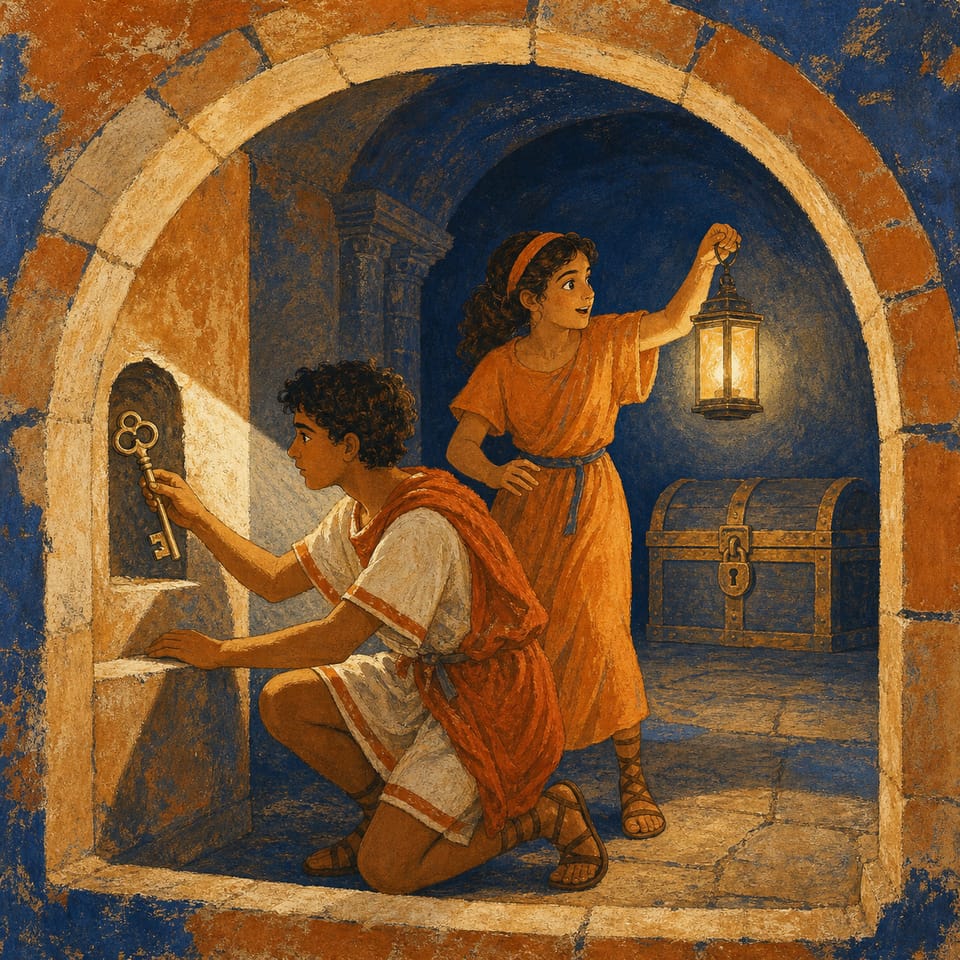
How do suspense and earned payoff shape a reader's experience?
Students will be able to
Plan and write an interactive story with clear setting, character, and problem
Use Boolean variables and if/else logic to control page navigation
Apply descriptive language and tone to enhance narration
Build interactive scenes using backgrounds, characters, and buttons
Debug and revise based on feedback and testing
Key vocabulary
sealsuspensepayoff
Assessment
Formative
Use milestone checks, organizer responses, and daily test evidence to guide feedback.
Summative
The opening, clue, search, discovery, and ending form one causal story, and the final treasure changes something meaningful. The key click sets the state, locked navigation respects that state, return buttons work, and the success page appears only after discovery.
The student journey
This is a build — not a worksheet packet
Every lesson runs like the story students are about to make: read it, write it, build it, polish it, publish it. The printables scaffold each stage — the published Elementari project is the destination.
1
📖
Read
Students read a short, high-interest passage — a real-world hook, not a dry textbook definition — to spark ideas for what they'll make.
📖Twenty-Two Days at a Sealed Door
On the fourth of November, 1922, in Egypt's Valley of the Kings, a workman's tool scraped something flat under the sand: a stone step. Then another. Howard Carter had been digging in that valley for years, season after season, and had found…
In the studio, students bring the project to life — adding art and following the exact writing and coding steps shown below. The Studio Compass walks them through it, one step at a time.
🧭Studio CompassStep 1 / 8
Plan Your Scene 🧠
Use your Writing Organizer to plan your game ( make a copy ). What is the setting? Who is the main character? What is locked? What is needed to open it? What kind of mood or tone w
Key words — tap to learnobject block
Each step checks off & advances on its own
All 8 studio steps · dynamic to the project
1Plan Your Scene 🧠
2Title Page 🎬
3Game Start + Player Instructions 📜
4Add Your Key Item 🔑
5Success Page 🎉
6Locked Chest Logic 🔒
7Code Navigation Buttons 🧭
8Make it Look Awesome 🎨
4
🔁
Polish
ongoing
Teacher and peer feedback pin right onto the project — students revise until it's ready to share.
Feedback on the project2 pins
🍎
Add one more sentence here so readers get the full picture.
👍 2Teacher
A
The interaction is clear — it helps the reader follow the project!
A couple of things to gather, a few quick steps to prep — then you're ready to hand it to students.
What you need
A device per student or pair
Internet connection
Prep · about 10 min
1Print the student kits
2Assign this lesson to your students
3Skim the build steps
Teacher background
What you need to know
Students learn that a locked reward transforms a reader into a player, but only when the search is fair and the reveal is worth the effort: the lock must be visible, the key must be findable, and the payoff must answer the suspense. They apply this by designing the search, the gate, and the reveal as one connected arc.
Key terms
seal
a stamped mark proving a door or container has stayed closed
suspense
the tense feeling of waiting to find out what happens
payoff
the satisfying reveal that rewards earlier effort and waiting
Watch for these misconceptions
✕
The READER is told to find an item that is invisible, unhinted, or unrelated to the lock. →Add a clue and make the key visually discoverable before increasing difficulty.
✕
The ending opens without the key or stays locked after the key is found. →Show the Boolean value during testing and test false and true conditions separately.
Standards alignment
Aligned to the standards you teach
Every task maps to a specific standard, so planning and reporting are covered.
Tracking 7 frameworks: Common Core ELA, Common Core Math, NGSS +4
CCSS · ELA2CSTA5ISTE73 frameworks · 14 standards · DOK 3
CCSS · ELA
Common Core State Standards — English Language Arts
2 standards
CCSS.ELA-LITERACY.W.7.5
With guidance and support from peers and adults, develop and strengthen writing as needed by planning, revising, editing, rewriting, or trying a new approach.
Also addressedCCSS.ELA-LITERACY.W.7.6
CSTA
CSTA K–12 Computer Science Standards
5 standards
2-AP-17
Systematically test and refine programs using a range of student-created inputs.
2-AP-11
Create clearly named variables that represent different data types and perform operations on their values.
2-AP-13
Decompose problems and subproblems into parts to facilitate the design, implementation, and review of programs.
Also addressed2-AP-15 · 2-AP-19
ISTE
ISTE Standards for Students
7 standards
ISTE 1.4.a
Students know and use a deliberate design process for generating ideas, testing theories, creating innovative artifacts, or solving authentic problems.
ISTE 1.4.c
Students develop, test, and refine prototypes as part of a cyclical design process.
ISTE 1.6.d
Students publish or present content that customizes the message and medium for their intended audiences.
ISTE 1.5.d
Students understand how automation works and use algorithmic thinking to develop a sequence of steps to create and test automated solutions.
Also addressedISTE 1.1.c · ISTE 1.6.b · ISTE 1.5.c
Full task-by-task mapping — including Depth of Knowledge — is in the answer key.
Differentiation & accessibility
Built to reach every learner
One lesson, three built-in paths — with accessibility baked into the materials, not bolted on afterward.
Extra support
Emerging readers & writers
Read-aloud and multilingual support in the Elementari build
Studio Compass highlights one task at a time — including the coding
Sentence frames and a word bank so it is never a blank page
On grade
The core lesson
The passage and storyboard exactly as written
Model answers and “look-fors” in the answer key
Self-check chips at every milestone
Ready for more
Extension & challenge
Challenge vocabulary and a real-world extension question
Deepen one existing page or interaction — without changing the required mechanics
A longer, evidence-based reflection prompt
Accessibility, built inPredictable step-by-step structureOne task at a time · Studio CompassHighlighted response areasLow-stimulation printMovement-friendly pacingDesigned so every student can design, write, and code — with ADHD, autism, and dyslexia in mind.
Questions
Teacher FAQ
Do I — or my students — need to know how to code?
No. Coding concepts are introduced in plain language exactly when students need them, and Studio Compass confirms each milestone so students keep moving without you troubleshooting. The teacher guide walks you through the whole build, answers included.
How long does this lesson take?
About 130, paced into 45-minute class periods. You can spread it out or compress it — students pick up where they left off, so it doesn't have to finish in one sitting.
What devices does this lesson work on?
Students can read, write, code, and publish on Chromebooks, iPads, tablets, laptops, or desktops. All they need is a modern browser — nothing to download or install.
What is Studio Compass?
Studio Compass is the step-by-step guide inside the Studio. It shows students what to do next, identifies the exact coding blocks they need, and confirms completed milestones so they can keep moving independently.
How does this lesson support different learners?
This lesson includes read-to-me with synchronized highlighting, a built-in glossary, and picture-based storyboarding, with writing and coding scaffolds you can dial up or down. Students can work with guided support or more independently — and still finish the same project.
Ready when you are
Bring this lesson to your class
Import your class, assign in one click, and watch them build — the whole kit comes with it.