code a drag interaction that starts an animation and page navigation
Key vocabulary
colonyjobfungus
Assessment
Formative
Use the worksheet and finished project to check each student's understanding during the lesson.
Summative
Assess each student's completed project and explanation.
The student journey
This is a build — not a worksheet packet
Every lesson runs like the story students are about to make: read it, write it, build it, polish it, publish it. The printables scaffold each stage — the published Elementari project is the destination.
1
📖
Read
Students read a short, high-interest passage — a real-world hook, not a dry textbook definition — to spark ideas for what they'll make.
📖The Ants' Secret Garden
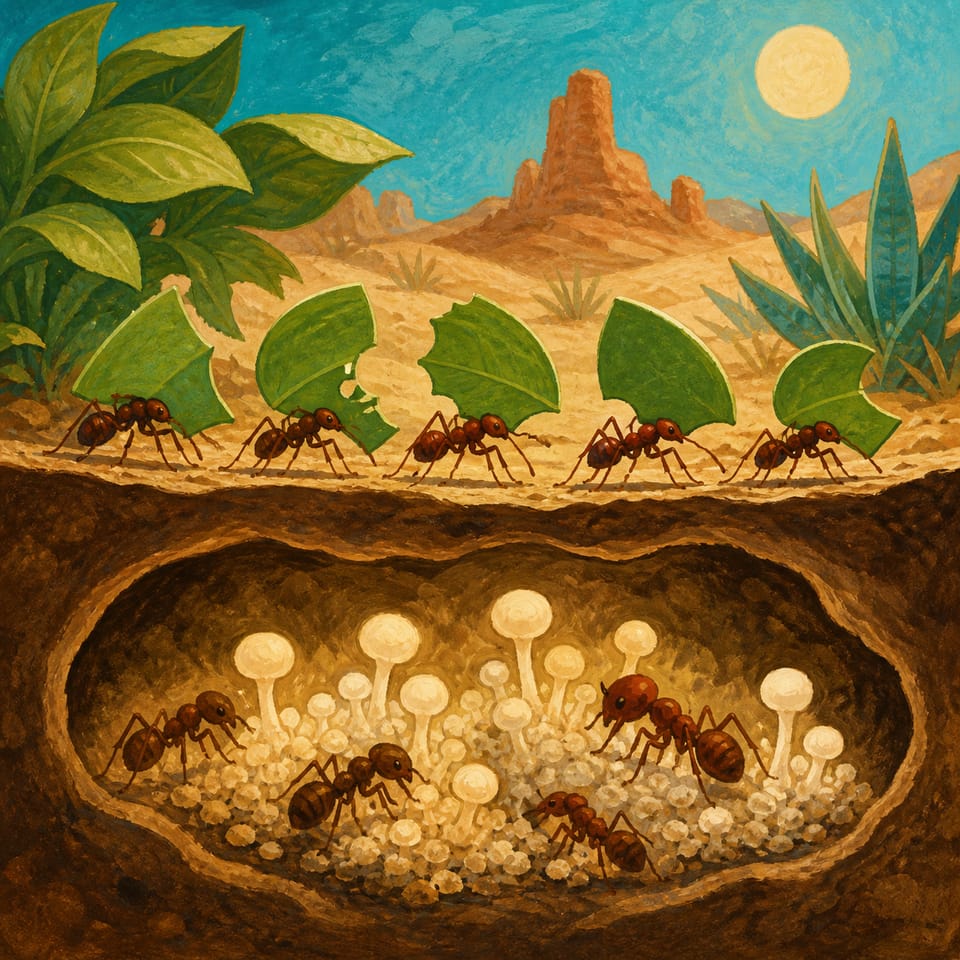
In the rainforest, a long line of Atta leafcutter ants marches along. Each ant carries a big piece of a green leaf. The leaf is much bigger than the ant! These ants live together in a big group called a colony. In the colony, different ants…
In the studio, students bring the project to life — adding art and following the exact writing and coding steps shown below. The Studio Compass walks them through it, one step at a time.
🧭Studio CompassStep 1 / 2
Build the cover
Key words — tap to learnOn Drag
Each step checks off & advances on its own
All 2 studio steps · dynamic to the project
1Build the cover
2Introduce Ati's job
4
🔁
Polish
ongoing
Teacher and peer feedback pin right onto the project — students revise until it's ready to share.
Feedback on the project2 pins
🍎
Add one more sentence here so readers get the full picture.
👍 2Teacher
A
The interaction is clear — it helps the reader follow the project!
A couple of things to gather, a few quick steps to prep — then you're ready to hand it to students.
What you need
A device per student or pair
Internet connection
Prep · about 10 min
1Print the student kits
2Assign this lesson to your students
3Skim the build steps
Teacher background
What you need to know
Ants share different jobs (cutting, carrying, cutting into bits, and tending a fungus garden). When many ants do these jobs together, leaves get to the nest and the fungus garden grows.
Key terms
colony
A group of animals that live and work together.
job
A special work one ant does to help the group.
fungus
A living thing that grows and can be food for ants.
Watch for these misconceptions
✕
Speech missing one required part (name, ant identity, or job action). →Ask the student to point to the sentence that says the ant's name, then to the sentence that says the ant is a leafcutter ant, and help them add the missing sentence.
✕
Job action is unclear or not connected to the passage (vague verbs like 'does things'). →Prompt with the passage: 'Which job did the passage talk about? Can you say that job using one word like "carry" or "cut"?'
✕
Students copy the example exactly instead of using their own words. →Encourage students to use the sentence starter then change one word to make it their own (for example, change 'carry' to 'bring').
Standards alignment
Aligned to the standards you teach
Every task maps to a specific standard, so planning and reporting are covered.
Tracking 7 frameworks: Common Core ELA, Common Core Math, NGSS +4
CCSS · ELA3CSTA1AASL13 frameworks · 5 standards · DOK 1–3
CCSS · ELA
Common Core State Standards — English Language Arts
3 standards
L.K.1
Use frequently occurring nouns and verbs.
Also addressedW.K.3 · W.K.2
CSTA
CSTA K–12 Computer Science Standards
1 standard
EK-PRO-PD-04
Create a sequence of commands to solve a problem or express an idea.
AASL
AASL National School Library Standards
1 standard
I.B.3
Learners engage with new knowledge by following a process that includes generating products that illustrate learning.
Full task-by-task mapping — including Depth of Knowledge — is in the answer key.
Differentiation & accessibility
Built to reach every learner
One lesson, three built-in paths — with accessibility baked into the materials, not bolted on afterward.
Extra support
Emerging readers & writers
Read-aloud and multilingual support in the Elementari build
Studio Compass highlights one task at a time — including the coding
Sentence frames and a word bank so it is never a blank page
On grade
The core lesson
The passage and storyboard exactly as written
Model answers and “look-fors” in the answer key
Self-check chips at every milestone
Ready for more
Extension & challenge
Challenge vocabulary and a real-world extension question
Deepen one existing page or interaction — without changing the required mechanics
A longer, evidence-based reflection prompt
Accessibility, built inPredictable step-by-step structureOne task at a time · Studio CompassHighlighted response areasLow-stimulation printMovement-friendly pacingDesigned so every student can design, write, and code — with ADHD, autism, and dyslexia in mind.
Questions
Teacher FAQ
Do I — or my students — need to know how to code?
No. Coding concepts are introduced in plain language exactly when students need them, and Studio Compass confirms each milestone so students keep moving without you troubleshooting. The teacher guide walks you through the whole build, answers included.
How long does this lesson take?
About 1 week, paced into 45-minute class periods. You can spread it out or compress it — students pick up where they left off, so it doesn't have to finish in one sitting.
What devices does this lesson work on?
Students can read, write, code, and publish on Chromebooks, iPads, tablets, laptops, or desktops. All they need is a modern browser — nothing to download or install.
What is Studio Compass?
Studio Compass is the step-by-step guide inside the Studio. It shows students what to do next, identifies the exact coding blocks they need, and confirms completed milestones so they can keep moving independently.
How does this lesson support different learners?
This lesson includes read-to-me with synchronized highlighting, a built-in glossary, and picture-based storyboarding, with writing and coding scaffolds you can dial up or down. Students can work with guided support or more independently — and still finish the same project.
Ready when you are
Bring this lesson to your class
Import your class, assign in one click, and watch them build — the whole kit comes with it.