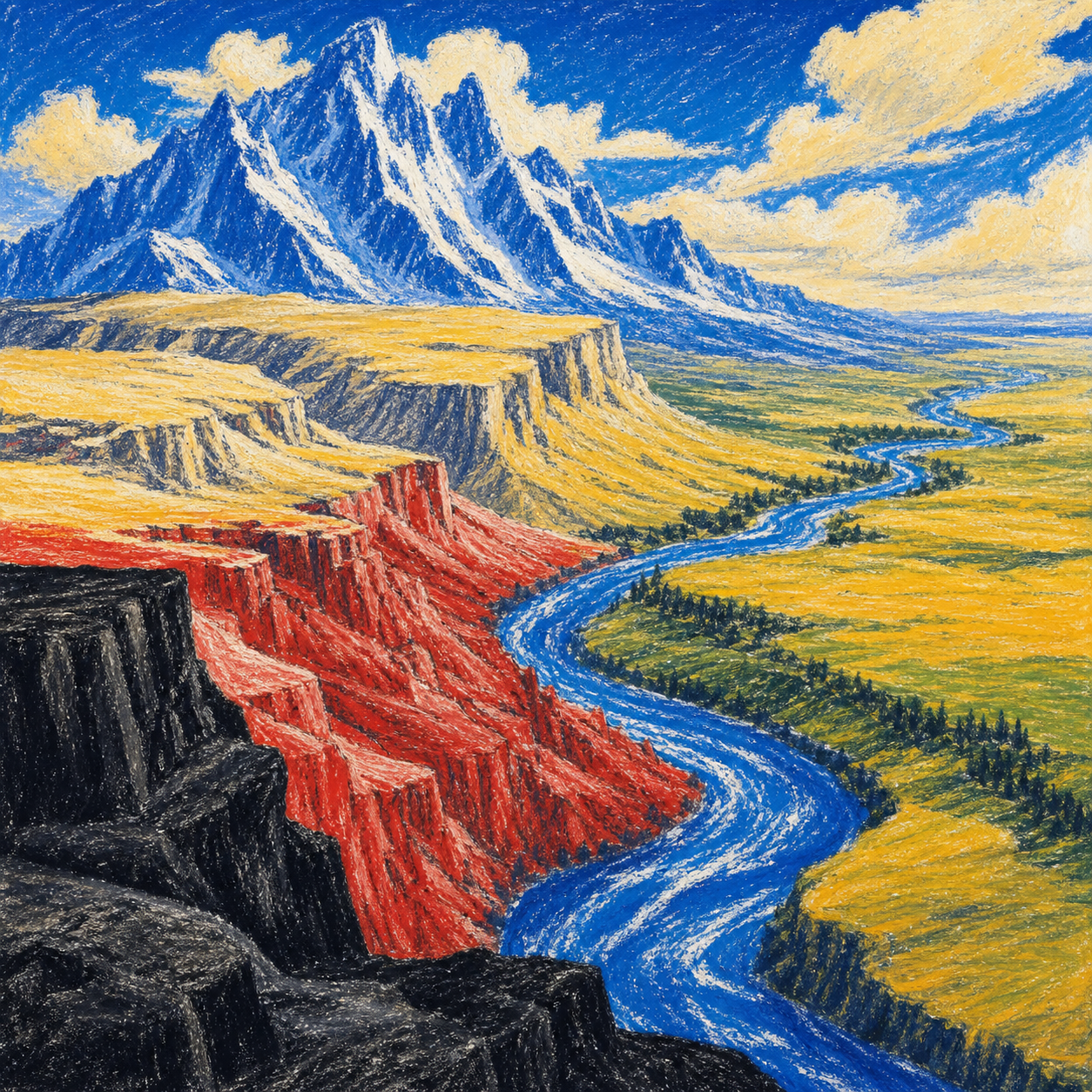
Create an interactive U.S. landform map using Elementari. Students explore geography, write nonfiction, and code pages that teach human-environment interaction.
Pacing
3 classes · 120 min
Grade
Grade 7
Coding
Beginner
Students codePlayer ActionsDragOn Page StartSequence
Opens a private practice project in the Studio — no account needed.
How do landforms shape human life — and how do humans reshape landforms?
Students will be able to
Research and summarize information about two U.S. landforms
Explain how landforms form and how they affect people
Write structured nonfiction paragraphs using academic vocabulary
Design and code an interactive U.S. map using Elementari
Key vocabulary
wetlandpeatrestorationContinental Divide
Assessment
Formative
Use milestone checks, organizer responses, and daily test evidence to guide feedback.
Summative
Both landforms are accurately located and explained, and each human use, challenge, and adaptation connects to physical geography. Dragging to each icon opens the matching pages, return navigation works, the fun-fact reveal is accurate, and locked navigation preserves exploration.
The student journey
This is a build — not a worksheet packet
Every lesson runs like the story students are about to make: read it, write it, build it, polish it, publish it. The printables scaffold each stage — the published Elementari project is the destination.
1
📖
Read
Students read a short, high-interest passage — a real-world hook, not a dry textbook definition — to spark ideas for what they'll make.
📖The Swamp America Paid to Un-Drain
A century ago, Florida declared war on a landform. Politicians of the era promised to drain what they called a worthless, disease-ridden swamp — the Everglades — and canal by canal, they did. Water that had crept slowly south for thousands …
SourcesU.S. National Park Service — Everglades National ParkAmerican Society of Civil Engineers — Moffat Tunnel Historic Landmark
In the studio, students bring the project to life — adding art and following the exact writing and coding steps shown below. The Studio Compass walks them through it, one step at a time.
🧭Studio CompassStep 1 / 11
Choose Your Landforms 📋
Pick two U.S. landforms to research using the Landform Research List . Complete your Landform Pre-Writing Organizer for each landform. See the Example Project .
Key words — tap to learnobject block
Each step checks off & advances on its own
All 11 studio steps · dynamic to the project
1Choose Your Landforms 📋~90 min
2Create Your Title (Page 1) 🖼️~10 min
3Interactive Map 1/2 (Page 2) 🗺️~10 min
4Landform #1: Geography 🌎 (Page 3)~10 min
5Landform #1: Impact 👣 (Page 4)~10 min
6Interactive Map 2/2 (Page 2) 🗺️~10 min
7Fun Fact Animation (Page 2) 🗺️~10 min
8Landform #2: Geography 🌎 (Page 5)~10 min
9Landform #2: Impact 👣 (Page 6)~10 min
10Lock Your Navigation 🔒~5 min
11Final Testing & Creativity 🎨~35 min
4
🔁
Polish
ongoing
Teacher and peer feedback pin right onto the project — students revise until it's ready to share.
Feedback on the project2 pins
🍎
Add one more sentence here so readers get the full picture.
👍 2Teacher
A
The interaction is clear — it helps the reader follow the project!
A couple of things to gather, a few quick steps to prep — then you're ready to hand it to students.
What you need
A device per student or pair
Internet connection
Prep · about 10 min
1Print the student kits
2Assign this lesson to your students
3Skim the build steps
Teacher background
What you need to know
Students learn that a landform is an active system, not scenery: it stores water, blocks travel, feeds ecosystems, and creates risk, and human responses (draining, tunneling, restoring) carry consequences that can take a century to surface. They apply this by researching two landforms and mapping both directions of the relationship.
Key terms
wetland
land covered or soaked by water for long periods
peat
soil made of packed, partly decayed plants, which can burn when drained
restoration
repairing a damaged natural system toward its original working state
Continental Divide
the ridge of high ground deciding whether rivers flow east or west
Watch for these misconceptions
✕
The geography and human-impact paragraphs read as unrelated fact lists. →Require each human use or challenge to connect explicitly to a physical feature or process.
✕
The map icon opens the wrong landform or a detail page cannot return. →Color-code each icon, destination page, and return route before editing navigation blocks.
Standards alignment
Aligned to the standards you teach
Every task maps to a specific standard, so planning and reporting are covered.
Tracking 7 frameworks: Common Core ELA, Common Core Math, NGSS +4
CCSS · ELA5CSTA4ISTE11AASL3NGSS15 frameworks · 24 standards · DOK 2–3
CCSS · ELA
Common Core State Standards — English Language Arts
5 standards
CCSS.ELA-LITERACY.W.7.2
Write informative/explanatory texts to examine a topic and convey ideas and information clearly.
CCSS.ELA-LITERACY.W.7.5
With guidance and support from peers and adults, develop and strengthen writing as needed by planning, revising, editing, rewriting, or trying a new approach.
CCSS.ELA-LITERACY.W.7.7
Conduct short research projects to answer a question, drawing on several sources and generating additional related questions when appropriate.
CCSS.ELA-LITERACY.W.7.8
Gather relevant information from multiple authoritative print and digital sources, assess source credibility and accuracy, quote or paraphrase while avoiding plagiarism, and follow a standard citation format.
Also addressedCCSS.ELA-LITERACY.W.7.6
CSTA
CSTA K–12 Computer Science Standards
4 standards
2-AP-17
Systematically test and refine programs using a range of student-created inputs.
2-AP-13
Decompose problems and subproblems into parts to facilitate the design, implementation, and review of programs.
Also addressed2-AP-15 · 2-AP-19
ISTE
ISTE Standards for Students
11 standards
ISTE 1.4.a
Students know and use a deliberate design process for generating ideas, testing theories, creating innovative artifacts, or solving authentic problems.
ISTE 1.4.c
Students develop, test, and refine prototypes as part of a cyclical design process.
ISTE 1.6.d
Students publish or present content that customizes the message and medium for their intended audiences.
ISTE 1.5.d
Students understand how automation works and use algorithmic thinking to develop a sequence of steps to create and test automated solutions.
Also addressedISTE 1.3.a · ISTE 1.3.b · ISTE 1.1.c · ISTE 1.6.b · ISTE 1.6.c · ISTE 1.5.c · ISTE 1.3.d
AASL
AASL National School Library Standards
3 standards
AASL I.A.1
Learners display curiosity and initiative by formulating questions about a personal interest or a curricular topic.
Also addressedAASL I.B.1 · AASL I.B.3
NGSS
Next Generation Science Standards
1 standard
NGSS MS-ESS2-2
Construct an explanation based on evidence for how geoscience processes have changed Earth’s surface at varying time and spatial scales.
Full task-by-task mapping — including Depth of Knowledge — is in the answer key.
Differentiation & accessibility
Built to reach every learner
One lesson, three built-in paths — with accessibility baked into the materials, not bolted on afterward.
Extra support
Emerging readers & writers
Read-aloud and multilingual support in the Elementari build
Studio Compass highlights one task at a time — including the coding
Sentence frames and a word bank so it is never a blank page
On grade
The core lesson
The passage and storyboard exactly as written
Model answers and “look-fors” in the answer key
Self-check chips at every milestone
Ready for more
Extension & challenge
Challenge vocabulary and a real-world extension question
Deepen one existing page or interaction — without changing the required mechanics
A longer, evidence-based reflection prompt
Accessibility, built inPredictable step-by-step structureOne task at a time · Studio CompassHighlighted response areasLow-stimulation printMovement-friendly pacingDesigned so every student can design, write, and code — with ADHD, autism, and dyslexia in mind.
Questions
Teacher FAQ
Do I — or my students — need to know how to code?
No. Coding concepts are introduced in plain language exactly when students need them, and Studio Compass confirms each milestone so students keep moving without you troubleshooting. The teacher guide walks you through the whole build, answers included.
How long does this lesson take?
About 210, paced into 45-minute class periods. You can spread it out or compress it — students pick up where they left off, so it doesn't have to finish in one sitting.
What devices does this lesson work on?
Students can read, write, code, and publish on Chromebooks, iPads, tablets, laptops, or desktops. All they need is a modern browser — nothing to download or install.
What is Studio Compass?
Studio Compass is the step-by-step guide inside the Studio. It shows students what to do next, identifies the exact coding blocks they need, and confirms completed milestones so they can keep moving independently.
How does this lesson support different learners?
This lesson includes read-to-me with synchronized highlighting, a built-in glossary, and picture-based storyboarding, with writing and coding scaffolds you can dial up or down. Students can work with guided support or more independently — and still finish the same project.
Ready when you are
Bring this lesson to your class
Import your class, assign in one click, and watch them build — the whole kit comes with it.